


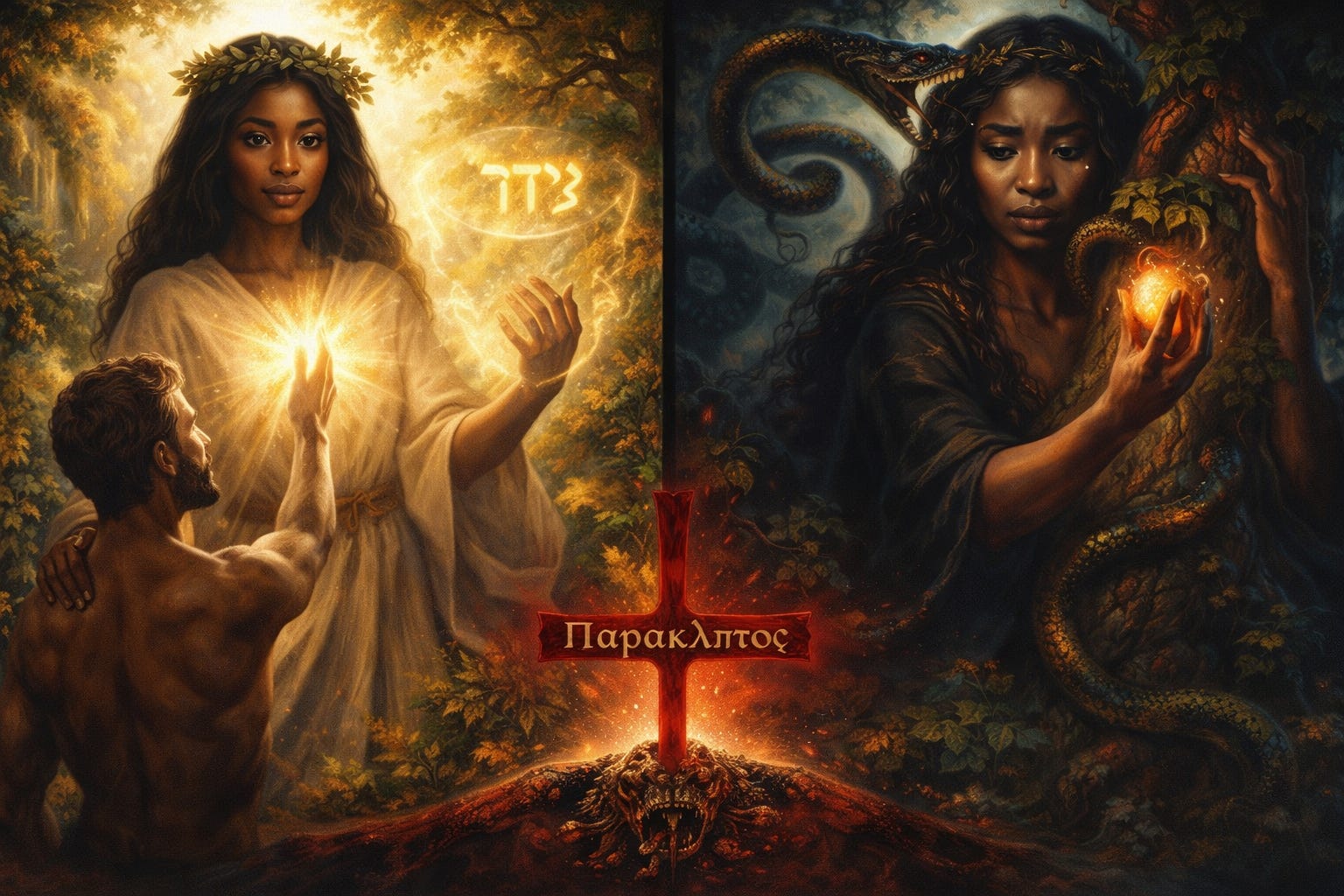
In part I, I presented that Eve was not a subordinate but an Ezer — a divine-strength helper, a woman of valor.
But that makes the next question unavoidable.
If Eve was so strong, how did the Fall happen?
Why did the Ezer — the rescuer, the mirror, the strength of Adam’s hand — fall first?
The Bible gives a clear, unsettling answer.
The serpent did not go after Adam.
He went after the Ezer.
Genesis 3:1 says, “Now the serpent was more crafty than any other beast of the field that the Lord God had made.”
And he said to the woman — not to the man — “Did God actually say, ‘You shall not eat of any tree in the garden’?”
The serpent targeted Eve because she was the strategic asset.
In military terms, you don’t attack the fortress walls first.
You disable the strong right hand of the commander.
Satan knew that if he could deceive the Ezer, the whole army would fall.
And the text records the tragedy.
Eve listened.
She saw that the tree was good for food, a delight to the eyes, and desirable to make one wise (Genesis 3:6).
She took its fruit and ate.
But here is the detail most people skip.
The same verse says: “She also gave some to her husband who was with her, and he ate.”

Adam was standing right there.
He did not stop her.
He did not correct the serpent.
He did not intervene as the one who first received the command directly from God (Genesis 2:16–17).
He watched his Ezer being deceived — and then he joined her.
The apostle Paul later draws a careful distinction in 1 Timothy 2:14.
“Adam was not deceived, but the woman was deceived and became a transgressor.”
Eve was tricked.
Adam made a clear-eyed choice.
She was misled; he rebelled.
That distinction matters.
It does not excuse Eve.
But it explains why the Bible treats the Fall as Adam’s fault (Romans 5:12–14).
Sin entered the world through one man, Paul writes.
Not because Eve was weaker, but because Adam was the federal head of humanity.
He was the one given the command directly.
He was the one who abdicated his responsibility while standing next to his deceived Ezer.
So what happened the moment they ate?
Their eyes were opened.
They saw their nakedness and hid.
Shame entered where only innocence had lived.
Fear replaced trust.
And then God pronounced the curse.
To the serpent, God said: “I will put enmity between you and the woman, and between your offspring and her offspring; he shall bruise your head, and you shall bruise his heel” (Genesis 3:15).
That verse is called the Protoevangelium — the first gospel.
It promises that the woman’s offspring will crush the serpent’s head.
Even in judgment, God does not abandon the Ezer.
He announces that her future child will destroy the very power that deceived her.
But the immediate consequence was catastrophic.
The Fall opened the door.
Sin entered like venom into a bloodstream.
Romans 5:12 says, “Just as sin came into the world through one man, and death through sin, and so death spread to all men because all sinned.”
That venom — pride, lust, violence, greed, every corruption — has flowed through every human vein since.
And it poisoned the relationship between the Ezer and her husband.
God said to Eve: “Your desire shall be contrary to your husband, and he shall rule over you” (Genesis 3:16).
This was not God’s original design.
The original design was ezer kenegdo — face-to-face, equal strength, mutual rescue.
The Fall twisted that into a desire to control and a rule by force.
Patriarchy as we know it is not God’s ideal.
It is a symptom of the venom.
So where does this leave us?
It leaves us with a sobering truth: strength does not make you immune to deception.
Eve was an Ezer — a divine-strength warrior — and she was still deceived.
Her power did not protect her from the serpent’s craft.
If anything, it made her a greater target.
The enemy does not waste his arrows on the weak.
He aims at the strong.
But the story does not end with the Fall.
The rest of the Bible is the story of God antidoting the venom.
He promises a seed of the woman who will crush the serpent’s head.
That seed is Jesus.
And Jesus, in turn, surrounded himself with Ezers.
Mary Magdalene, Joanna, Susanna — women who supported his ministry from their own resources (Luke 8:1–3).
Priscilla, who alongside Aquila, corrected Apollos’s theology (Acts 18:26).
Junia, called “outstanding among the apostles” (Romans 16:7).
The Fall did not erase the design of the Ezer.
It wounded it.
And redemption restores it.
In Christ, Paul writes, “There is neither male nor female, for you are all one in Christ Jesus” (Galatians 3:28).
The venom is being drained.
The Ezer is being raised again to her original place — not a ruler over Adam, not a servant under him, but the strength of his hand, face-to-face, rescuing and being rescued.
So here is the companion truth to the first article.
Yes, Eve was the Ezer — the powerful ally, the divine-strength helper.
But even the strongest hand can be deceived.
And when it is, the whole world falls.
That is not an indictment of womanhood.
It is a testament to how much God entrusted to her.
The serpent did not bother with the rib.
He went straight for the right hand.
Because he knew: take down the Ezer, and the army collapses.
But the gospel says: the Ezer gets the last word.
Her offspring crushes the serpent’s head.
The venom is cured.
And the strength of God’s hand is finally, fully, forever restored.